gh them and how soon you’ll see your desired results.
1. Consistency and Adherence
This is arguably the most critical factor. Sporadic workouts will yield sporadic results. To truly adapt and change, your body needs a consistent stimulus. Aim for at least 3-5 challenging workouts per week, coupled with active recovery on other days. The more consistent you are, the faster your body will respond.
2. Type of Workout and Program Design
Different types of workouts elicit different responses.
- Strength Training: Excellent for building muscle and increasing strength. Visible changes in muscle mass might take 8-12 weeks for beginners, with more advanced lifters seeing slower but steady gains.
- Cardiovascular Training: Primarily improves endurance, heart health, and aids in calorie burning for fat loss. Improvements in stamina can be felt within a few weeks, while noticeable body composition changes, when combined with diet, might take longer.
- Flexibility and Mobility Training: Enhances range of motion and reduces injury risk. Improvements can be felt relatively quickly, often within 2-4 weeks of consistent practice.
The overall design of your program also matters. Is it progressive? Does it include a variety of exercises? Is it tailored to your goals? A well-structured program will accelerate your progress.
3. Nutrition and Diet
You cannot out-train a bad diet. Nutrition plays a monumental role in workout results, particularly for body composition changes.
- For Muscle Gain: You need a caloric surplus (eating more calories than you burn) and sufficient protein intake to fuel muscle repair and growth.
- For Fat Loss: You need a caloric deficit and adequate protein to preserve muscle mass while losing fat.
- Overall Health: A balanced diet rich in whole foods, fruits, vegetables, and healthy fats provides the micronutrients necessary for optimal bodily function, recovery, and energy levels.
Without proper nutrition, your body simply won’t have the building blocks or energy to recover and adapt effectively.
4. Sleep and Recovery
Often overlooked, sleep is when your body does much of its repair and rebuilding. During deep sleep, your body releases growth hormone, which is vital for muscle repair and fat metabolism. Aim for 7-9 hours of quality sleep per night.
Beyond sleep, active recovery (light activity, stretching, foam rolling) and rest days are crucial to prevent overtraining, reduce muscle soreness, and allow your body to fully adapt to the stress of your workouts.
5. Starting Point and Genetics
Your current fitness level significantly impacts how quickly you see results.
- Beginners: Often experience “newbie gains,” where they see relatively rapid improvements in strength and muscle mass in the first few months due to the novelty of the stimulus.
- Experienced Individuals: Progress tends to slow down over time as the body becomes more adapted. Gains become harder to achieve and require more precise training and nutrition.
Genetics also play a role in muscle-building potential, fat distribution, and metabolic rate. While you can’t change your genetics, understanding their influence can help you set realistic expectations.
6. Hormonal Balance
Hormones like testosterone, estrogen, growth hormone, and cortisol all influence muscle growth, fat storage, and recovery. Imbalances can impede progress. Factors like stress, sleep deprivation, and poor nutrition can negatively impact hormonal balance.
7. Age
As we age, our bodies undergo changes that can affect workout results. Muscle protein synthesis, for example, can become less efficient, and recovery times may lengthen. However, consistent exercise remains incredibly beneficial at any age, and results are still achievable, though perhaps at a slightly slower pace for some.
Realistic Timelines for Different Goals
Let’s break down some realistic timelines for common fitness goals, keeping in mind the influencing factors discussed above.
Strength Gains
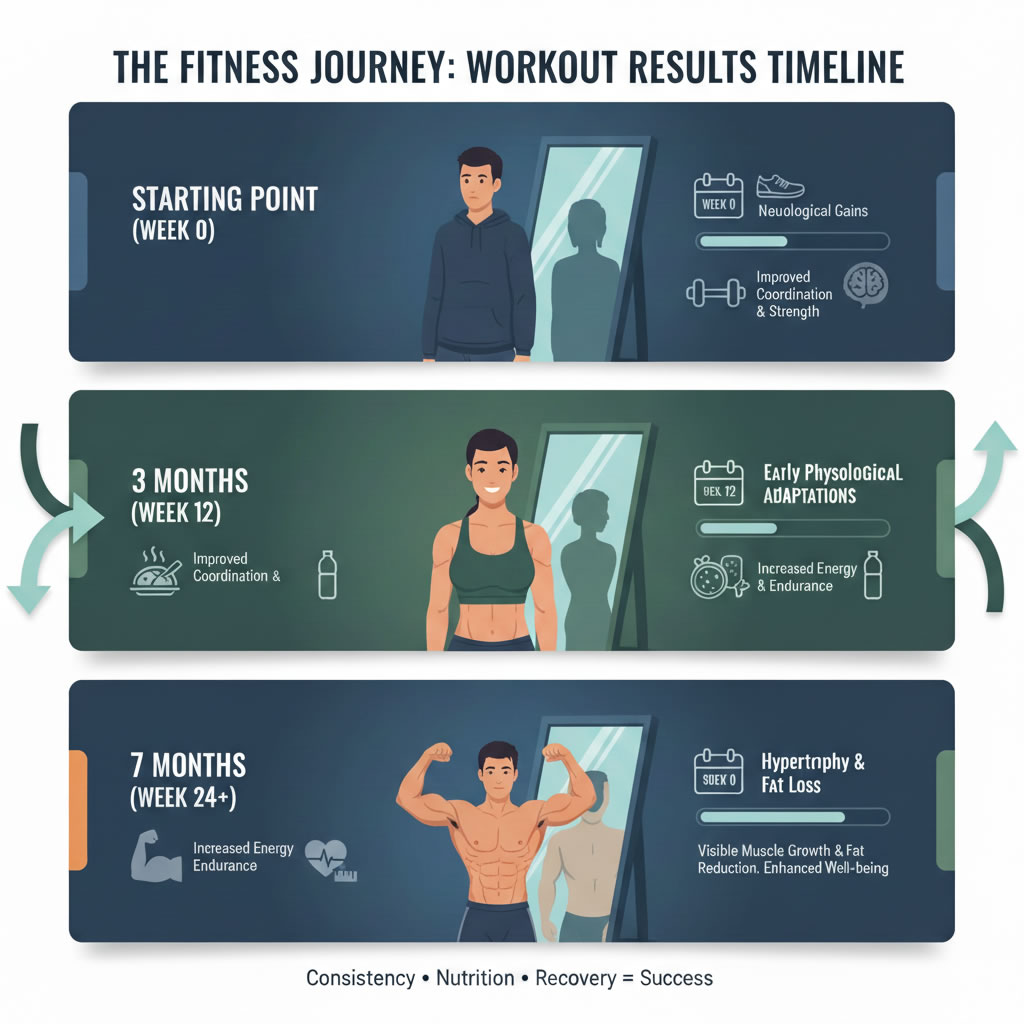
- Beginners (First 1-3 months): Significant increases in strength are common due to neurological adaptations. You might feel noticeably stronger within 2-4 weeks.
- Intermediate (3-12 months): Steady, consistent gains. Progress might be slower than the initial “newbie gains.”
- Advanced (1+ years): Gains become harder to achieve and require more strategic programming and progressive overload.
Muscle Growth (Hypertrophy)
- Visible changes for beginners: Typically 8-12 weeks of consistent, progressive strength training with adequate nutrition and rest.
- Noticeable changes for others: 3-6 months or more, depending on your starting point and dedication. It’s a gradual process that requires patience.
- Significant transformations: 1-2+ years of dedicated effort.
Fat Loss
- Feeling better/more energetic: Within 2-4 weeks of adopting a healthier diet and consistent exercise.
- Visible changes in clothes/mirror: 4-8 weeks, assuming a consistent calorie deficit and a combination of cardio and strength training.
- Significant body composition changes: 3-6 months or more, aiming for a healthy and sustainable rate of 1-2 pounds of fat loss per week.
Improved Cardiovascular Endurance
- Feeling less winded during daily activities: 2-4 weeks of consistent cardio.
- Improved performance in specific activities (e.g., running a longer distance): 4-8 weeks.
- Significant improvements in VO2 max: 3-6 months of progressive cardiovascular training.
Enhanced Flexibility and Mobility
- Feeling less stiff and increased range of motion: 2-4 weeks of consistent stretching and mobility work.
- Noticeable improvements in specific poses or movements: 1-3 months.
How to Optimize Your Journey for Faster Results
While patience is key, there are definitely ways to maximize your efforts and potentially see results sooner.
- Set SMART Goals: Specific, Measurable, Achievable, Relevant, Time-bound goals provide direction and help track progress. Instead of “I want to get fit,” try “I want to be able to run 5k in 30 minutes in 12 weeks.”
- Follow a Structured Program: Don’t just show up to the gym and wing it. A well-designed program, ideally from a certified personal trainer, will ensure you’re training effectively and progressively.
- Prioritize Progressive Overload: To continue making progress, you must continually challenge your body. This means gradually increasing the weight, reps, sets, duration, or intensity of your workouts over time.
- Master Your Nutrition: This cannot be stressed enough. Track your food intake, ensure adequate protein, and manage your calorie intake according to your goals. Consider consulting a registered dietitian for personalized guidance.
- Prioritize Sleep and Recovery: Aim for 7-9 hours of quality sleep. Incorporate active recovery, stretching, and rest days into your routine.
- Stay Hydrated: Water is essential for every bodily function, including muscle function, nutrient transport, and temperature regulation.
- Listen to Your Body: Pay attention to signs of overtraining, injury, or fatigue. Don’t push through pain. Rest when needed, and seek professional help if you experience persistent discomfort.
- Track Your Progress: Keep a workout journal, take progress photos, measure body circumference, or use a fitness tracker. Seeing objective improvements can be incredibly motivating.
- Be Patient and Consistent: This is a marathon, not a sprint. There will be plateaus and setbacks, but consistent effort over time will always yield results.
- Find Your Motivation: Whether it’s a fitness buddy, a challenging event, or simply the desire for better health, identify what truly motivates you to keep going.
- Seek Professional Guidance: A personal trainer can create a customized program, teach proper form, and help you break through plateaus. A registered dietitian can optimize your nutrition.
The Mental Aspect: Seeing Beyond the Mirror
It’s easy to get fixated on physical appearance, but remember that many significant results are not immediately visible.
- Improved Mood and Mental Health: Exercise is a powerful antidote to stress, anxiety, and depression. You might notice these benefits long before physical changes.
- Increased Energy Levels: Consistent activity often leads to more sustained energy throughout the day.
- Better Sleep Quality: Regular exercise can improve sleep patterns.
- Enhanced Self-Confidence: The act of setting and achieving fitness goals builds resilience and self-belief.
- Reduced Risk of Chronic Diseases: Exercise significantly lowers your risk of heart disease, type 2 diabetes, certain cancers, and other health issues.
These internal “wins” are just as, if not more, important than external changes and often manifest much sooner.
Dealing with Plateaus
At some point, you’ll likely hit a plateau where progress seems to stall. This is normal and can be frustrating, but it’s also an opportunity to re-evaluate and adjust your approach.
- Change Your Routine: Your body adapts quickly. Switch up your exercises, rep ranges, set schemes, or even the type of training you’re doing.
- Increase Intensity: Push yourself harder. Add more weight, do more reps, shorten rest times, or try advanced techniques like supersets or drop sets.
- Review Nutrition and Recovery: Are you getting enough protein? Are you consistently in a caloric surplus/deficit? Are you sleeping enough?
- Deload: Sometimes, a week of lighter training or complete rest can allow your body to fully recover and come back stronger.
- Seek Expert Advice: A trainer or coach can often identify blind spots in your program or technique.
Conclusion
So, how long does it take to see workout results? The short answer is: it varies. While you might feel better and stronger within a few weeks, visible changes in body composition typically take 2-3 months of consistent, dedicated effort, coupled with smart nutrition and adequate rest. Significant transformations can take 6 months to several years.
The most important takeaway is consistency. Show up, put in the work, nourish your body, prioritize recovery, and trust the process. Focus on the journey and the myriad of health benefits that extend far beyond aesthetics. Celebrate every small victory, whether it’s lifting a heavier weight, running a little further, or simply feeling more energized. Your body is an incredible adaptive machine, and with patience and persistence, it will respond. Keep going – your results are earned, not given.
About The Author